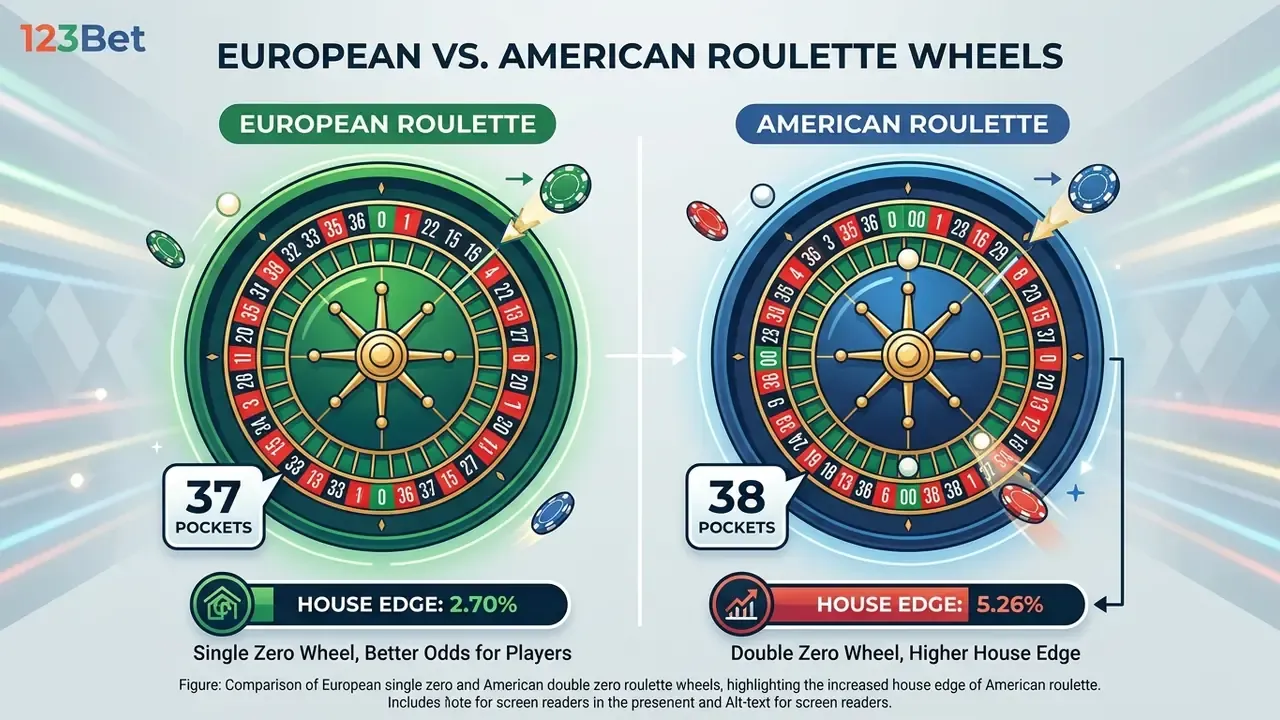
In roulette, payouts are calculated as if the wheel contained only 36 pockets, ignoring the zero sectors. That gap between true mathematical odds and actual payout multipliers is the house edge.
Take European roulette. A straight-up bet pays 35:1, yet there are 37 pockets, so the true odds against winning are 36 to 1. Expected value (EV) per unit staked works out as:
EV = (1/37 × 35) + (36/37 × -1) = (35 - 36)/37 = -1/37 ≈ -2.70%
The same formula applied to an even-money bet gives (18/37 × 1) + (19/37 × -1) = -1/37 ≈ -2.70%. Applied to the American five-number bet it gives (5/38 × 6) + (33/38 × -1) ≈ -7.89%.
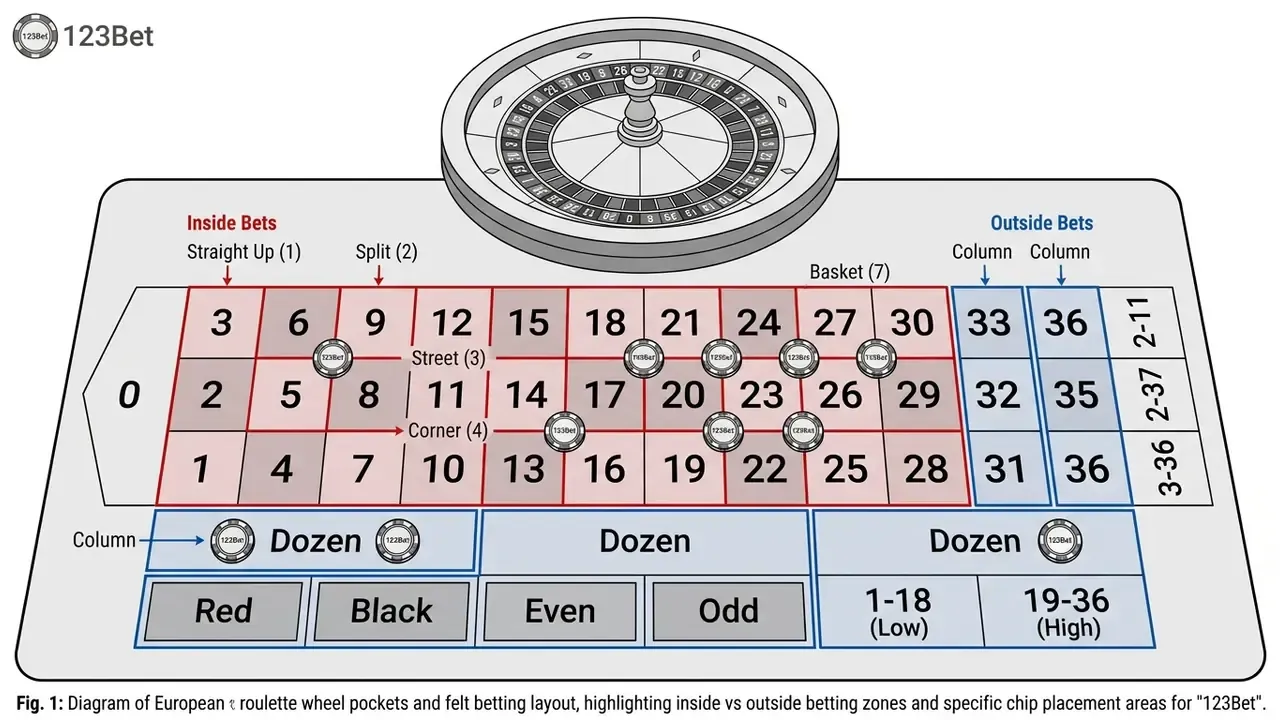
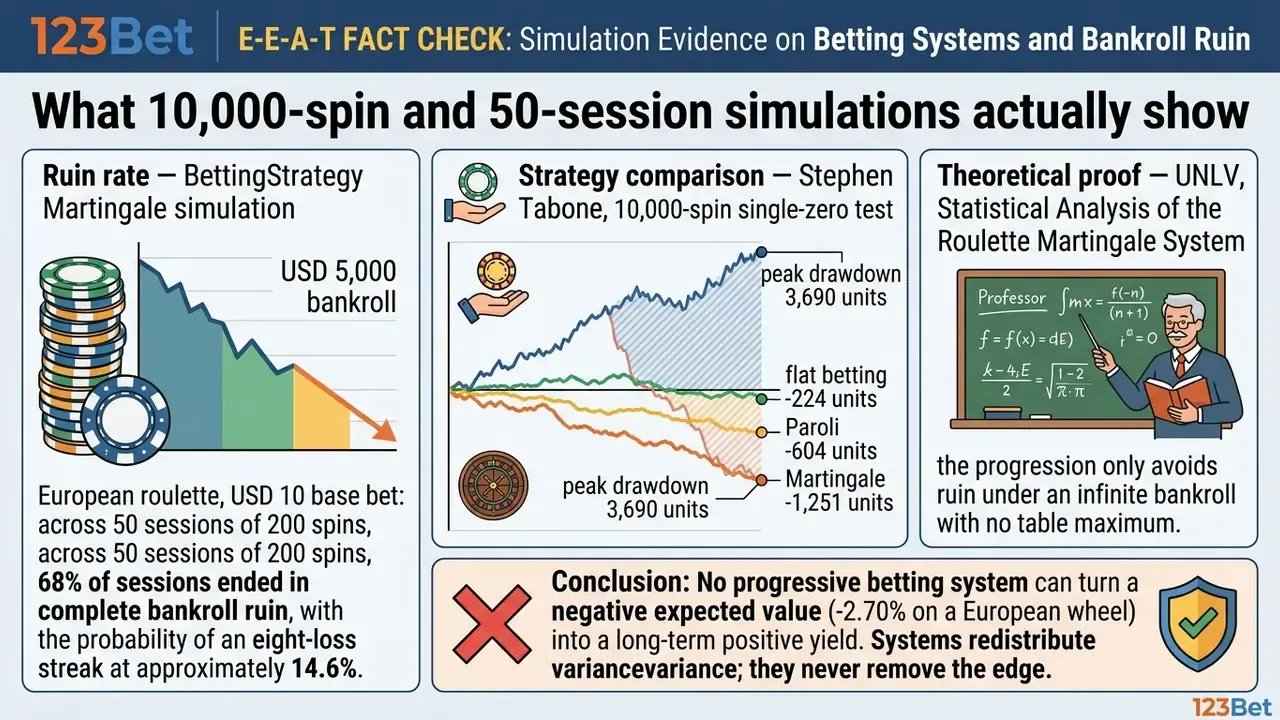
So the payout ratios swing dramatically between a Straight Up bet (35:1) and a Red/Black bet (1:1), while the underlying house edge stays at exactly 2.70% for all standard bets on a European wheel. Volatility changes. Expectation does not.
Table: Roulette Bet Types, Payouts and Win Probabilities