Poker Online: Rules, Game Formats, Demo Mode and Real-Money Play

Last reviewed: February 2026 | Reading time: ~18 minutes | Audience: Australian readers, 18+

Poker online in Australia covers three different things at once: peer-to-peer card tables, house-banked poker casino titles, and real-time live dealer broadcasts. Each one sits inside strict regulatory boundaries set by the Interactive Gambling Act 2001 (IGA). Digital card games are accessible entertainment, no argument there. But software mechanics, payout structures, bonus fine print and legal conditions all deserve a look before you act on anything.

"A useful poker review starts with regulatory facts and terms before presenting any headline offer or game benefit. Evaluating wagering requirements, payout rules and self-exclusion tools ensures players make informed choices based on verifiable evidence rather than promotional claims." Claire Bennett, Senior iGaming Editorial Lead

Before we get to formats and rules, you can review verified operator data, licensing details, bonus conditions and responsible gambling tools in our editorial hub on iGaming.


Poker Online Rules, Game Formats, Demo

Quick Verdict for Australian Readers

QuestionShort answer
Is real-money online poker legal in Australia?No. Providing real-money interactive poker or casino services to Australian residents is prohibited under the Interactive Gambling Act 2001. Offshore sites that accept Australians operate outside Australian consumer protection.
Can I legally play poker online at all?Yes, through play-money, social and club-based platforms that use virtual chips (for example Replay Poker or ClubGG), and in licensed land-based poker rooms.
Are poker winnings taxed?Recreational winnings are generally not taxable in Australia because they are treated as incidental income. Professional, business-like gambling activity is a different matter (see the taxation section).
Which format should a beginner learn first?Texas Hold'em: two hole cards, five community cards, four betting rounds.
Are credit cards or crypto allowed for online wagering?No. Since 11 June 2024, credit cards and cryptocurrencies are banned for online wagering in Australia.
Is poker skill or luck?Over large samples, skill dominates. Analysis of 456 million real-money hands shows performance persists across periods.
Biggest risk to watch?Harm density. Nearly six in ten online poker players screen at moderate-to-high risk of gambling harm.

Who this guide is for, and who should skip it

This guide suits three readers. First, the complete beginner who wants poker rules explained without jargon. Second, the player who already knows Hold'em and wants the Australian legal picture spelled out plainly. Third, the reader who has been shown an offshore poker bonus and wants to work out what it is actually worth.

Skip it if you are looking for an operator recommendation or a sign-up link for real-money poker. We do not provide either, because real-money online poker is not lawfully available to Australian residents. Skip it too if you are chasing losses. That is not an editorial position, it is arithmetic.

Who this guide is for, and

What poker is and which games are available online

In two sentences: Poker is a five-card betting discipline played against other people or against the house, delivered online through peer-to-peer software, RNG casino titles and streamed live dealer tables. In Australia, only play-money and social formats sit clearly inside the law, so understanding the categories matters before anything else.

A poker game is a strategic card discipline where participants aim to construct the strongest five-card hand, or to push opponents into folding through structured betting rounds. Online poker translates those traditional mechanics into digital environments: peer-to-peer networks, random number generator (RNG) casino software, and video-streamed dealer studios. According to the NSW Gambling Survey 2024, a representative study of 10,000 adults conducted by Central Queensland University, roughly 26.6% of adults take part in online gambling. Niche activities such as online poker show unusually high harm density, which is why regulatory awareness belongs at the start of any guide, not the end.

What poker is and which games

"59.6% of online poker participants meet the criteria for moderate or high-risk problem gambling, substantially higher than lottery users." NSW Gambling Survey 2024, NSW Responsible Gambling Fund & Central Queensland University (2024). https://www.nsw.gov.au/gambling/research

That single figure reframes the whole category. Poker attracts a comparatively small share of gamblers, yet the concentration of harm inside that group runs far higher than in mass-participation products such as lotteries. So reading rules, limits and self-exclusion options is part of learning the game. Not an afterthought.

Online poker, casino poker and live poker: the difference

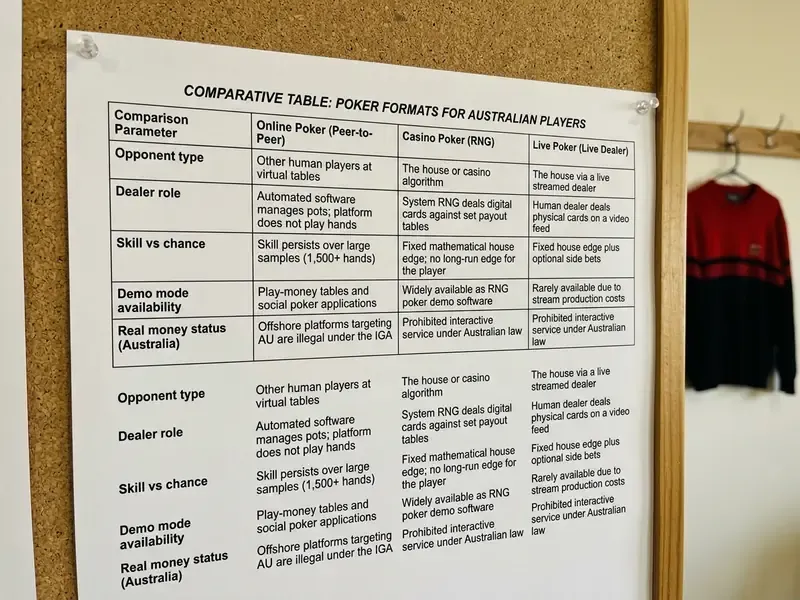
The primary distinction between online poker, casino poker and live poker sits in three places: the opponent model, the dealing mechanism, and the legal classification under Australian law. In peer-to-peer online poker, players compete against other human participants at shared tables, while the platform acts as a neutral host and collects a small commission (rake). In casino poker, the player competes directly against the house using fixed payout tables and RNG software certified for randomness, unpredictability and absence of bias. In live poker, a human dealer manages physical cards inside a studio and the action is broadcast by low-latency streaming.

Under the Interactive Gambling Act 2001, real-money interactive casino services aimed at Australian residents are prohibited, and enforcement bodies such as the Australian Communications and Media Authority act on them regularly. Readers comparing legal game categories can review how online casinos in Australia are classified and which formats remain accessible.

Online poker, casino poker and live

"ACMA blocked 47 illegal gambling websites, including casinos and poker rooms breaching the IGA, in the July to September 2024 quarter." ACMA, Action on interactive gambling: July to September 2024 (2024). https://www.acma.gov.au/

Enforcement is continuous rather than symbolic. Domain blocking, payment restrictions and public operator warnings land quarter by quarter. Which is exactly why an offshore poker room that worked last month may be unreachable this month, or unable to pay out at all.

Single-player poker games and shared-table play

Single-player poker games put one person against automated dealer software. Multiplayer tables ask you to read human psychology and positional dynamics instead. Single-player variants such as video poker or RNG-based Caribbean Stud run entirely on certified algorithms, with the mathematical house edge fixed into the rules themselves. Multiplayer poker play at virtual tables works differently: shared pots, and outcomes shaped by hand selection, position and decision quality across long sample sizes.

"Analysis of 456 million hands shows top-decile players consistently retain their positions in later periods, so skill dominates chance beyond roughly 1,500 hands." Beyond Chance? The Persistence of Performance in Online Poker, Nottingham Academic Repository (2024). https://nottingham-repository.worktribe.com/

This methodological detail matters more than the headline. Persistence of performance across separate time windows, not one winning session, is the statistical signature of skill. And that is precisely what separates peer-to-peer poker from purely chance-based casino products.

Texas Hold'em as the core poker format

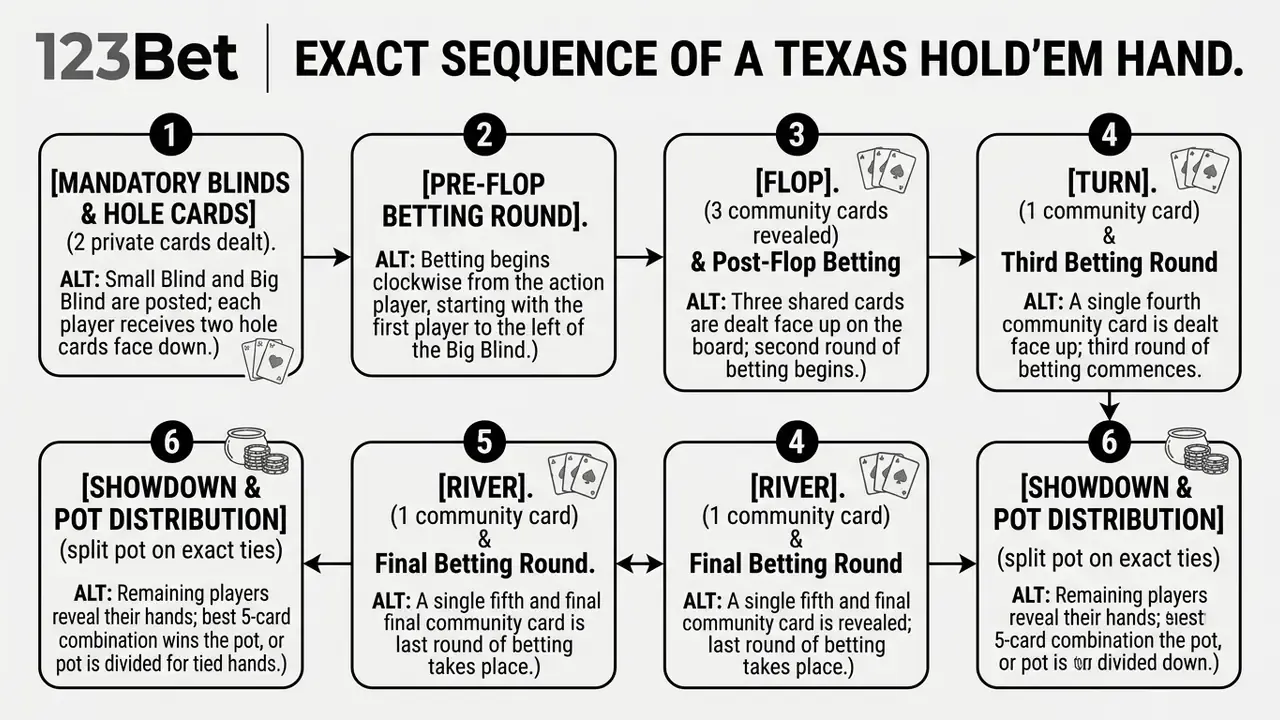
Texas Hold'em is the dominant global format of poker, built on a two-card private hand and five shared community cards. Each player receives two hole cards face down, followed by three dealing phases (flop, turn and river) that reveal five community cards in total.

Why has it travelled so far? Because it balances simple basic rules against deep strategic complexity. Two private cards are enough for a beginner to act, while the four-street betting structure creates the layered decisions professionals build careers on. Independent verification of "most popular format" claims is thin, so the more defensible statement is structural. Hold'em is the format used for the main events of the World Series of Poker (WSOP), for the majority of online multi-table tournaments, and for most live cash tables in Australian venues such as the Crown Perth poker room, where Ultimate Texas Hold'em and live cash games run seven days a week.

Texas Hold'em as the core poker

Parameter details: peer-to-peer online poker matches human opponents with software dealing. RNG casino poker pits single players against house algorithms, usually with instant demo access. Live dealer poker streams real human dealers, yet remains classified as a prohibited interactive service when offered for real money to Australian audiences under the Interactive Gambling Act 2001.

Poker rules: how a hand plays out and how the winner is decided

In two sentences: Every poker hand ends in one of two ways, either a showdown decided by hand rankings, or an uncontested pot when everyone else folds. The rest of the poker rules simply describe the order in which cards appear and in which players may act.

Across published rule sets, a hand goes either to the participant holding the highest-ranking five-card combination at showdown, or to the last player standing after all opponents fold during betting rounds. A standard 52-card deck is used without jokers, and play moves clockwise around the table. The structure guarantees that every bet feeds a central pot, which is awarded to the surviving or highest-ranking hand. In house games (casino and live dealer poker) the same hand hierarchy applies, but your hand is compared against the dealer's qualifying hand rather than against other players.

Poker rules how a hand plays

Cards, hands and poker combinations

A valid poker hand consists of exactly five cards, ranked by how improbable each combination is. The scale runs from High Card up to the Royal Flush:
  • High Card:no matching ranks or suits; judged by the highest card value.
  • One Pair:two cards of equal rank plus three kickers.
  • Two Pair:two separate pairs plus one kicker.
  • Three of a Kind:three cards of equal rank.
  • Straight:five consecutive card ranks of mixed suits.
  • Flush:five cards of the same suit in any order.
  • Full House:Three of a Kind combined with a separate Pair.
  • Four of a Kind:four cards of identical rank.
  • Straight Flush:five consecutive ranks of identical suit.
  • Royal Flush:Ten, Jack, Queen, King and Ace in a single suit.
Cards, hands and poker combinations. A

Kickers and tied hands: when two players hold the same combination, the highest unmatched card (the kicker) decides the pot. If both hole cards and all kickers match in rank, the pot splits evenly. Suits never break ties in Texas Hold'em.

Betting and the order of player actions

Betting action runs clockwise in distinct turns, starting from the mandatory forced bets known as the small blind and big blind. The small blind posts half the table's minimum bet and the big blind posts the full amount, both before seeing any cards, which is where the term "blind" comes from. When it is their turn, players choose one of five actions:

  1. Check: pass the action along without adding chips (only possible when no bet stands).
  2. Bet: place the first wager into the pot on that street.
  3. Call: match the highest active bet in the current round.
  4. Raise: increase the active wager, forcing later players to match the new amount or give up their cards.
  5. Fold: discard the hand and forfeit all chips already committed.

Position order: in live games the dealer button rotates one seat to the left after each hand, which keeps the positional advantage fair. Online, dealing is handled by a certified random algorithm and button rotation is automated. Early positions (Under the Gun) act with the least information; late positions (Cutoff, Button) act with the most. That asymmetry is the whole reason position matters.

Betting and the order of player

Example of a single Texas Hold'em hand

Under the standard Hold'em procedure, a round opens with two private hole cards dealt face down to each participant. Pre-flop betting starts with the player to the left of the big blind. After that, the dealer turns three community cards face up on the table (the flop), which triggers a second wagering round. A fourth community card (the turn) follows, then a third betting round. The fifth and final card (the river) leads to the last round of betting. If two or more players remain, a showdown determines the win based on the best five-card combination formed from any mix of hole and board cards. If only one player is left after any street, the pot is awarded immediately and nobody has to show cards.

Example of a single Texas Hold'em

In two sentences: Cash games, tournaments and Omaha differ in stack flexibility, session length and variance, not in hand rankings. Choosing between them is mostly a question of how much time and volatility you can absorb.

Modern online poker splits into distinct wagering formats: ring cash games, scheduled tournaments, and alternative rulesets such as Pot-Limit Omaha. Each suits a different goal, and each carries its own strategic volatility.

Want to work out which poker format actually suits you? Our Casino hub collects current reviews of poker rooms, cash games and tournament series, with a breakdown of bonus conditions and wagering requirements.

Cash games: playing for table stakes

In cash games, chips at the table carry direct monetary value, so players can join or leave between any two hands. Blind levels stay fixed, for example $1/$2, unlike the rising blinds of a tournament. Players can top up a stack or cash out chips instantly, which makes the format convenient for short, self-paced sessions. Because the stack is a cash-equivalent position rather than a fixed entry, buy-in sizing and re-buy discipline become your main risk controls. One practical habit: decide your re-buy cap before you sit, not after a bad beat.

Poker tournaments, freerolls and event formats

Poker tournaments require an entry buy-in that converts into tournament chips, with play running until one participant holds every chip in play. The main structures:
  • Multi-Table Tournaments (MTT):scheduled event formats where hundreds or thousands compete across shrinking tables for a share of a prize pool funded by buy-ins after fees.
  • Sit & Go (SNG):single-table tournaments that launch as soon as the seats fill, so the start time depends on registration rather than the clock.
  • Spin-style jackpot SNGs:three-handed hyper-turbo tournaments where the prize pool is randomised before the first hand is dealt.
  • Freerolls:free entry events funded by platforms or sponsors, paying cash prizes or satellite tickets without financial risk.
Poker tournaments, freerolls and event formats

Texas Hold'em versus Omaha: choosing a poker game

Texas Hold'em deals two hole cards. Pot-Limit Omaha (PLO) deals four. In PLO, a valid five-card hand must use exactly two hole cards plus exactly three community cards from the board. That structural constraint produces far more draws and much higher hand volatility than Hold'em, and it demands specialised hand selection: coordinated, double-suited holdings gain value, dangling low cards lose it, and paired boards turn dangerous quickly. Beginners often bring Hold'em instincts to PLO and overvalue two pair. It is an expensive habit.

Poker leagues and live tournament series

Skills built in demo and social formats transfer straight into live tournament structures. In Australia, the largest tiered system is the Australia Poker League (APL), which runs hundreds of local pub and club events each year alongside sizeable national finals, so beginners and experienced players sit in the same ecosystem. Internationally, the World Series of Poker (WSOP) remains the reference point. Its blind structures, level durations and payout curves are the template most online multi-table tournaments copy. Land-based venues add a third pathway. Dedicated poker rooms such as Crown Perth run live cash games seven days a week, typically 6pm to 4am on weekdays and from midday on weekends, with the specific games set by player demand, and they offer loyalty points for hours played rather than online-style rakeback.

Poker leagues and live tournament series

Poker live dealer and live casino: playing with a real dealer

In two sentences: Live dealer poker streams a human dealer handling physical cards from a studio, with your decisions transmitted digitally. Legally, for Australians it is treated exactly like an online casino game, not like peer-to-peer poker.

The poker live dealer format bridges software interfaces and physical gaming tables by streaming a human dealer from a purpose-built studio. Unlike standard RNG software, poker live casino titles pair real physical card dealing with optical character recognition (OCR) that instantly turns table action into interactive screen controls, alongside multi-camera HD video, timed betting windows and dealer chat.

Poker live dealer and live casino

"Live dealer poker streamed to Australian users for real money is classified as a prohibited interactive service, in the same category as online casino games." ACMA, Action on interactive gambling: October to December 2024 (2024). https://www.acma.gov.au/

One structural point separates this vertical from peer-to-peer poker completely: bluffing plays no role. You are competing against a fixed pay table and a dealer qualification rule, not against readable opponents.

Live Casino Hold'em, Caribbean Stud, Three Card Poker and other variants

Popular live casino poker variants adapt standard poker rules into house-banked structures built for continuous streaming:
  • Live Casino Hold'em:the player posts an ante and receives two hole cards while the dealer also receives two. Three community cards are dealt, then the player calls or folds to compare five-card hands against the dealer's qualifying hand, typically a Pair of Fives or better. Ante payouts on premium hands can reach 100:1.
  • Live Caribbean Stud Poker:both player and dealer receive five cards, one dealer card face up. The dealer must qualify with Ace-King or better for raise bets to receive full table payouts; if the dealer fails to qualify, the ante is paid at even money. Progressive and "5+1 Bonus" side bets can pay up to 1000:1.
  • Live Three Card Poker:a simplified, high-tempo variant using three-card hand rankings, where Three of a Kind outranks a Straight, usually with two independent wagers, Ante and Pair Plus.
  • Live Royal / Russian Poker:a dealer-versus-player variant where, after the initial five-card deal, the player can Swap cards or Buy a sixth card for the price of the ante. Some tables even let the player "help the dealer qualify" when a large payout is at stake.
  • Bet-On Live Poker:a betting-slip format where participants wager on the outcome of a hand between virtual positions, with dynamic odds recalculated at each street (pre-flop, flop, turn, river).
  • Side Bet City and similar hybrids:a base hand supplemented by optional side wagers on specific combinations, with payouts fixed by the table's pay table.
Live Casino Hold'em, Caribbean Stud, Three

How to choose a live poker table

Selecting a suitable live poker table means auditing its operational parameters:

  1. Minimum and maximum limits: check the stake requirements against your bankroll rules.
  2. Dealer qualification rules: review the hand the house needs to qualify. These vary by venue and directly affect expected return.
  3. Side bet tables: examine side wager rules such as Pair Plus or 21+3, and the house edge attached. It is typically higher than on the main bet.
  4. Interface speed: confirm that video latency and turn timers leave you time to think.
  5. Rule transparency: the full pay table and rule sheet should be published on the table itself, not only in marketing material.
How to choose a live poker

Compare live dealer table reviews, stake limits, dealer qualification rules and available poker variants in one place on Casino.

Poker demo and free poker: how to start without risk

In two sentences: Demo and play-money poker teach interface handling, hand rankings and betting flow at zero financial cost. They are the only clearly lawful way for Australians to play poker online, though they also carry documented behavioural risks worth knowing about.

A poker demo or free play mode lets you experience digital card mechanics using virtual practice credits instead of real capital. Testing games through poker demo software means beginners can play poker without financial exposure while they learn software navigation, pot dynamics and turn timers.

"Australian research on 826 adolescents found that participants in simulated gambling were significantly more likely to engage in real money gambling." Peer-reviewed study on adolescent simulated gambling, Australian samples (n=826 and n=843), 2024.

Disclaimer: demo mode uses virtual credits with no real-world value and does not reflect results achievable in real-money play. This information is general in nature and does not replace advice from a responsible gambling specialist.

What a poker demo gives a beginner

Using a poker demo helps a new player get comfortable with interface layouts, automated betting sliders and hand evaluation displays. Practice environments let you test basic poker rules, watch how quick-fold mechanics behave, and rehearse hand selection without risking funds. In practice, demo play solves four discrete tasks: learning the interface, rehearsing the rules, understanding betting street by street, and testing basic skills such as position-based hand selection.

One structural limitation deserves a plain explanation. In genuine peer-to-peer poker there is no true "demo" against real opponents. The game needs a shared pot and identifiable seats, so practice play always means either an account with play-money chips or a social club application. RNG casino poker is different: instant demo access, no account required, because there is no second human at the table.

What a poker demo gives a

For players in Australia, where real-money interactive services are restricted by the IGA, access to competitive and educational poker runs through two lawful models:

  • Browser-based social platforms (for example Replay Poker): no download needed, since play runs straight in the browser. Gameplay uses virtual chips, with daily login bonuses that scale from roughly 500 up to 2,500 chips by day five, weekly streak rewards, round-the-clock Sit & Go and multi-table events, plus freerolls with no financial risk. Thousands of players are usually online at once, so tables fill fast.
  • Club-based mobile applications (for example ClubGG): these support private club games and tournaments across iOS, Android, Windows and APK builds. The model excludes direct money stakes inside the app, using tournament tickets and closed club events for skill development instead. Account creation often happens inside the app rather than in a browser. Trying to convert club play into real money through external payout systems is not recommended for Australian residents, because that moves the activity outside the lawful free-play framework.

Both models cover the same learning ground as real-money tables, position, ranges, bet sizing and tournament structure, without triggering IGA issues or payment restrictions.

Legal platforms for free play and

When to move from free poker to money play

Moving from free software to real money play calls for discipline on three fronts: bankroll safety, legal compliance and emotional control. Free games build mechanical familiarity, sure, but virtual credits never replicate the pressure of actual stakes. People call wider, bluff looser and tilt less in play money, precisely because nothing is lost.

"From September 2024, computer games containing simulated gambling carry a mandatory R18+ classification in Australia, restricting access for minors." Australian Government, Department of Infrastructure, Transport, Regional Development, Communications and the Arts (2024). https://www.infrastructure.gov.au/

Readiness checklist before any real-money consideration: you can state the ten hand rankings without hesitation; you know your opening range by position; you hold a fixed bankroll figure separate from living expenses; you have deposit and time limits set; you have verified the legal status of the platform in your jurisdiction; and you accept that no demo result predicts a real-money outcome.

Offshore real-money poker: risks Australians must understand

In two sentences: The sections below explain how real-money poker offers, bonuses and payments work, because Australians are routinely marketed those offers by offshore operators. Understanding the mechanics is not the same as endorsing participation, and the legal position is unambiguous.

Providing real-money online poker to Australian residents is prohibited under the Interactive Gambling Act 2001, regardless of where the operator is based. Amendments in 2017, 2019 and 2024 tightened that further by adding payment restrictions and expanded blocking powers. Australian land-based operators face the same wall: Crown Perth, for instance, states plainly that the federal internet gaming moratorium prevents it from offering online gambling at all.

Red flags of offshore poker rooms, a practical checklist:

  • No effective recourse. If an offshore site freezes a balance or refuses a withdrawal, Australian regulators cannot compel payment. ACMA can block the site. It cannot recover your funds.
  • Licence claims that cannot be verified. A logo is not a licence. If the licence number does not resolve on the regulator's own register, treat the claim as absent.
  • Payment workarounds. Requests to pay via crypto, gift cards, third-party "processors" or personal transfers signal that legitimate rails have already refused the operator.
  • Bonus terms that change after registration. Retroactive edits to wagering requirements, maximum cashout caps buried in clause 14, or "irregular play" clauses broad enough to void any winnings.
  • KYC only at withdrawal. Sites that accept deposits instantly, then demand extensive documentation the moment you cash out, are using verification as a friction tool.
  • Blocked or rotating domains. Frequent mirror domains usually mean the operator is already subject to enforcement action.
  • No responsible gambling tools. Missing deposit limits, session timers or self-exclusion is a warning sign in itself, and it means BetStop registration will not protect you there.

The safest reading of the legal position for an Australian resident: play-money, social and club platforms for online practice, licensed land-based poker rooms for real-money play.

Offshore real-money poker risks Australians must

Poker real money: how offers, bonuses and rewards work

In two sentences: Poker bonuses are almost never free cash, they are contingent credit released as you generate rake. Reading the release mechanism, expiry window and cashout cap tells you more than the headline number ever will.

Working through poker real money promotions means reading fine print, playthrough requirements and eligibility restrictions rather than the big number on the banner. Operators present several incentive structures, welcome match credits, reload incentives and ticket packages among them, yet every offer carries specific contractual terms. Readers can compare current casino bonus offers and their release conditions side by side.

In two sentences Poker bonuses are

"A review of 30 studies found bonuses encourage increased betting among most players, with problem gamblers reporting greater bonus-driven impact on their behaviour." Playtech Protect Research Brief (2023).

Welcome bonus, deposit bonus and poker tickets

A bonus in online poker is rarely handed over as withdrawable cash. It unlocks incrementally, based on playing activity:
  • Welcome match bonus:a percentage match on a first deposit, released in increments, for example $10 for every $50 paid in rake.
  • Poker tickets:complimentary tournament entries granted for specific event structures or satellite qualifiers, usable in place of a cash buy-in.
  • Reload incentives:match offers on later deposits, subject to strict expiry dates and game-weighting rules.
  • Chip packages (social platforms):on free-play sites the equivalent perk is a virtual chip bundle, say 65,000 chips for a nominal $0.99 first purchase, which carries no cash redemption value whatsoever.
Welcome bonus, deposit bonus and poker

Worked example: how much rake clears a $100 bonus

Bonus terms get easier to judge once you convert them into hours at the table. Using illustrative figures typical of a 100% match up to $100, released at $5 per 100 loyalty points, where 1 point equals $1 of rake paid:

StepCalculationResult
Bonus to clear$100$100
Release rate$5 per 100 points20 release steps
Points required20 × 1002,000 points
Rake required2,000 points × $1$500 in rake
Rake generated per hour~$0.30/hand × 200 hands/hour~$60/hour
Time to clear$500 ÷ $60~8.3 hours of play
Expiry window30 daysFeasible, but only with steady volume

The lesson is arithmetic, not promotional. A "$100 bonus" with a 30-day window is worth $100 only if your normal volume produces $500 of rake inside that window. If it produces $200, the realistic value is $40. If the terms also impose a maximum cashout, the effective ceiling drops again. Run this calculation before opting in, every time.

Rakeback, VIP tiers and community rewards

Rakeback, as the term is used across poker platforms, is a partial refund of the rake commission a platform collects during cash game or tournament play. Standard community rewards and VIP structures calculate returns from accumulated volume, giving a percentage of paid fees back to the player as direct cash or promotional chips. Typical mechanics: tiered percentages that rise with monthly rake contribution, weekly or monthly settlement cycles, and expiry of unclaimed rewards.

Because rakeback is calculated from fees you have already paid, it reduces cost rather than creating profit. That distinction matters when you compare a high advertised rakeback rate at a high-rake room against a modest rate at a low-rake room. The second room often leaves more in your pocket. Land-based rooms use a different model again: loyalty points per hour of play, for example 50 rewards points per hour at Crown Perth, instead of a percentage of rake.

Rakeback, VIP tiers and community rewards

Real-money poker conditions to check before acting

Before accepting any promotional offer or depositing funds for poker real money play, work through the full framework:

  • Check playthrough or wagering coefficients, meaning how much rake must be generated per bonus unit.
  • Verify expiry timeframes, usually 7 to 30 days to clear unlocked funds.
  • Confirm maximum withdrawal limits (bonus caps) and game contribution weighting.
  • Confirm the operator's licence number resolves on the issuing regulator's public register.
  • Confirm which responsible gambling tools exist: deposit limits, loss limits, session timers, cool-off and self-exclusion.
  • Review accepted payment channels and the jurisdictional restrictions attached to them.
Real-money poker conditions to check before

"From 11 June 2024, credit cards and cryptocurrencies are banned for online wagering in Australia as part of ACMA's player protection measures." ACMA, Compliance Priorities 2024 to 25 (2024). https://www.acma.gov.au/

Taxation, payments and KYC for Australian players

In two sentences: Recreational gambling winnings are generally untaxed in Australia; professional, business-like play is not. Payment rules sit under separate regulation, with credit cards and crypto now prohibited for online wagering.

Taxation of poker winnings

Under Australian Taxation Office (ATO) guidance, poker winnings earned by recreational players are generally not taxable, because they are treated as incidental income rather than assessable earnings. Most casual players, whether at a local club, on a social platform or in a live tournament, do not need to declare them.

The position shifts where gambling is conducted on a professional, systematic, profit-seeking basis. Then the activity may be characterised as carrying on a business, winnings become assessable income that must be declared, and related expenses are deductible under ordinary business rules. One further point gets overlooked constantly: income derived from illegal activity remains taxable, while losses and expenses connected to that activity cannot be claimed as deductions. In practice, playing on a prohibited or unlicensed platform gives you no tax advantage and strips away the ability to offset losses.

Disclaimer: this is general information only and does not constitute tax, financial or legal advice. Individual circumstances vary, so consult a registered tax agent or the ATO directly before making decisions.

Taxation of poker winnings. Under Australian

Payments and withdrawals: what applies in Australia

MethodStatus for online wagering (AU)Typical withdrawal timeframe
Credit cardsProhibited since 11 June 2024Not applicable
CryptocurrenciesProhibited since 11 June 2024Not applicable
Debit cardsPermitted for licensed wagering1 to 3 business days
Bank transfer / PayIDPermitted for licensed wagering2 to 5 business days
E-wallets (PayPal, Skrill, Neteller)Availability depends on operator and jurisdiction24 to 48 hours (fastest option)
Prepaid vouchersDeposit only in most casesWithdrawal usually redirected to bank

Note that advertised timeframes begin after verification is complete, not after you submit the request. First withdrawals are almost always the slowest, because KYC is triggered at that point.

KYC documentation checklist

  • Proof of identity:valid passport or Australian driver licence, full colour, all four corners visible, unexpired.
  • Proof of age:18+ in Australia, though some jurisdictions apply a 21+ threshold.
  • Proof of address:utility bill, bank statement or council notice issued within the last three months.
  • Proof of payment ownership:card image with middle digits masked, or a screenshot of the e-wallet account showing the registered name.
  • Source of funds:requested for larger transactions under anti-money-laundering obligations.
KYC documentation checklist

Names on the payment instrument, the account and the identity document must match exactly. Third-party payments are the single most common cause of blocked withdrawals. Not a coincidence, and not usually negotiable.

Poker strategy: improving your game and your decisions

In two sentences: Good poker strategy replaces intuition with a repeatable decision framework built on position, ranges and bankroll rules. The evidence that this effort pays off is statistical, not anecdotal.

Developing an effective poker strategy means dropping guesswork for a structured, mathematically sound decision model. The fundamentals sit in four places: starting hand selection, table position, bankroll preservation, and disciplined execution across every street. Readers building a risk framework can start with poker bankroll management.

"Research across 456 million hands confirms skill statistically dominates chance from samples of about 1,500 hands, making strategic discipline the decisive factor in results." Beyond Chance? The Persistence of Performance in Online Poker, Nottingham Academic Repository (2024). https://nottingham-repository.worktribe.com/

Starting poker strategy for Texas Hold'em

A disciplined poker strategy for Texas Hold'em rests on these pillars:

  1. Positional awareness: acting last on post-flop streets gives you maximum information. Players in late position (Button, Cutoff) can play a wider range than those Under the Gun.
  2. Tight-aggressive starting ranges: premium hands such as high pairs (AA, KK, QQ) and strong suited broadways (AK, AQ) should be raised, not limped. A workable beginner range: from early position, pairs 99+ and AJs+; from the Button, add suited broadways, suited connectors and small pairs.
  3. Bankroll management: as a widely used practitioner convention, not a regulated standard, many coaching frameworks recommend risking no more than 1% to 2% of a total poker bankroll on a single cash game buy-in or tournament entry, so natural variance does not end the project. The logic is variance-based: the higher the format's volatility, with PLO and turbo MTTs above Hold'em cash, the more conservative that fraction should be.
  4. Using backdoor draws for semi-bluffs: backdoor flushes and straights, which need favourable cards on both turn and river, create genuine equity-bluff opportunities. Opponents fold more often to a second barrel when the board texture plausibly completes a hidden combination, and the bluff keeps real outs when called.
  5. Check-raising the flop: a check-raise out of position against the pre-flop aggressor knocks out weak continuation ranges and seizes initiative in the pot. It works because the raiser's continuation-betting range is wide by construction, so much of it cannot withstand pressure.
  6. Playing suited connectors: hands like 8♠9♠ or J♥Q♥ carry high hidden-combination potential, straights and flushes, in deep-stacked play. Implied odds justify calling them in position against wide opens. In shallow stacks the same hands become traps, since they cannot realise their draw equity.
  7. Bluffing and board reading: a bluff is a bet made with a hand unlikely to win at showdown, designed to fold out better holdings. Profitability depends on the board telling a credible story. Bluffs on textures that plausibly hit your perceived range succeed far more often than random aggression.
  8. Tilt and session discipline: emotional control is a measurable edge. Set a stop-loss in buy-ins per session, take a mandatory break after two consecutive large losing pots, and never move up in stakes to recover a loss. Chasing and playing tired are the two most expensive habits in amateur poker.
Starting poker strategy for Texas Hold'em

FAQ for Australian players

What to do next

  1. Learn the hand rankings cold. Use the ten-combination list above until recall is instant.
  2. Play 500 hands of play-money Hold'em on a social platform, focusing only on position and starting hands.
  3. Write your own bankroll rule before considering any stake, and set deposit and time limits in the same sitting.
  4. Verify the legal status of any platform for your jurisdiction, and check the licence number against the regulator's register.
  5. Take it live. An APL pub event or a licensed poker room is the lawful route to real-money play for Australian residents.
  6. Compare verified operator and format reviews in our Casino hub before committing anything.
What to do next. 1. Learn

How this guide was reviewed

Our editorial team audits gaming guides against a fixed framework: regulatory status first, then game mechanics, then commercial terms. In assembling this guide, reviewers examined how different poker structures present conditions to users, checking table mechanics and structural rules across peer-to-peer, RNG and live dealer formats. That review confirmed one consistent finding. Transparent information on buy-ins, blind escalation and rake caps is what lets a reader assess game risk objectively, while headline bonus figures presented without release mechanics do not. Regulatory claims in this article were checked against ACMA publications, the Interactive Gambling Act 2001, ATO guidance and Australian classification reforms. Statistical claims were checked against the NSW Gambling Survey 2024 and the Nottingham repository study on performance persistence. The page is re-checked when legislation, payment rules or platform terms change, and the last-reviewed date at the top reflects that check.

About the author: Claire Bennett is Senior iGaming Editorial Lead, with experience auditing operator terms, bonus mechanics and responsible gambling compliance across Australian and international markets.

General disclaimer: this article is educational and general in nature. It is not financial, legal, tax or medical advice. Gambling involves risk of financial loss. 18+ only. If gambling is causing harm, contact the National Gambling Helpline on 1800 858 858 or register with BetStop.

How this guide was reviewed. Our