Plinko Online: Free Demo, Game Rules, and Real-Money Play Explained

Last reviewed and updated: August 2026 | Reviewed by the editorial team at iGaming Content Hub | 18+ only

«Before you look at any headline bonus or big multiplier in Plinko, check the fine print, the underlying volatility, and the payout conditions. A responsible review starts with what can be verified about the game's mechanics and licensing.» Claire Bennett, Senior iGaming Editor (source: editorial brief).

Plinko began life as a broadcast game-show segment. It now sits among the most visible casual casino-style titles online, sharing shelf space with crash games and dice. The appeal is obvious: a ball, a wall of pegs, a number under each pocket. Simple.

The maths underneath is less simple. Understanding how the game actually operates, from its binary pegboard mechanics to its published return-to-player (RTP) figures, is what separates an informed session from a hopeful one. That applies whether you are testing plinko free credits or moving to real cash.

Want to try Plinko without money on the line first? Casino lists demo builds alongside licensed real-money titles with published RTP figures and round-the-clock support. Terms apply, and demo play is still 18+.

Provider

BGaming

RTP

99%

Volatility

Medium

Min bet

€1

Max bet

20 EUR

Max win

140.000 EUR

Plinko Online Free Demo, Game Rules

Plinko in 60 Seconds

  • What it is:A digital Galton board. A ball falls through rows of pegs, each peg forcing a 50/50 left-or-right deflection, and the slot it lands in sets the multiplier applied to your stake.
  • The maths:Outcomes cluster in the centre. Central slots usually pay below 1.0x (0.2x to 1.0x), edge slots pay from 5x up to 1,000x, and 10,000x on some builds. Hitting the outermost slot on a 16-row board is roughly a 1-in-65,536 event.
  • RTP:Typically 96% to 99% depending on the provider (BGaming publishes 99%, Spribe 97%). Changing the risk level does not change the expected return. It only changes the shape of the volatility.
  • Demo versus real money:Demo modes run the same RNG and multiplier tables as cash play, but nothing can be withdrawn. Demo play is still classified as simulated gambling and is 18+.
  • Strategy reality check:Martingale and Anti-Martingale cannot beat the house edge in Plinko, largely because sub-1x central slots produce partial losses rather than clean binary losses.
  • Australian context:ACMA and AUSTRAC regulate the space; identity verification must be completed before an account is opened. Self-exclusion is available nationally through BetStop.
Plinko in 60 Seconds

Why This Matters if You Are Playing From Australia

Plinko looks like a toy. That is precisely why it deserves a careful read before you deposit.

Three things shape the Australian experience specifically. First, most sites offering real-money plinko casino play to Australians hold offshore licences, which means consumer protection sits with a foreign regulator rather than an Australian body. Second, verification rules tightened in September 2024: ID checks now happen before an account exists, not after a withdrawal request. Third, the pace of the game is unusually fast. A round resolves in roughly 4.5 seconds, so turnover accumulates far quicker than in pokies or table games.

Put those together and the practical question is not «can I win?». It is «do I know the terms, the limits and the exit points before I start?». The sections below work through that in order: mechanics, then demo play, then real money, then risk, then the tools that keep a session contained.

Why This Matters if You Are

What is Plinko and How Does It Work?

Plinko is a casual online casino game built on the physics of a Galton board. A dropped ball bounces through rows of staggered pegs before settling in a payout slot along the bottom. Each peg collision is a probabilistic left-or-right deflection, which makes the game a digital binomial process: the landing slot dictates the multiplier applied to your stake (Australian Gambling Research Centre, 2024).

«The probability of hitting the outermost slot on a 16-row board is 1 in 65,536, roughly 0.00305% per drop.» Source: Australian Gambling Research Centre and provider analysis synthesis (2024). https://123bets-au.com

In plain language: the pegboard is a lottery of coin flips. To reach the far-left or far-right pocket, every single flip has to fall the same way, sixteen times in a row. To land in the middle, thousands of different flip combinations will do the job. That asymmetry is the entire game.

The board itself was devised by Francis Galton in the 19th century to demonstrate the binomial and normal distributions. Modern Plinko monetises the demonstration: same lattice, same statistics, but with multipliers printed under each bin and a stake attached to every drop. Nothing has been invented since. Only the graphics changed.

In plain language the pegboard is
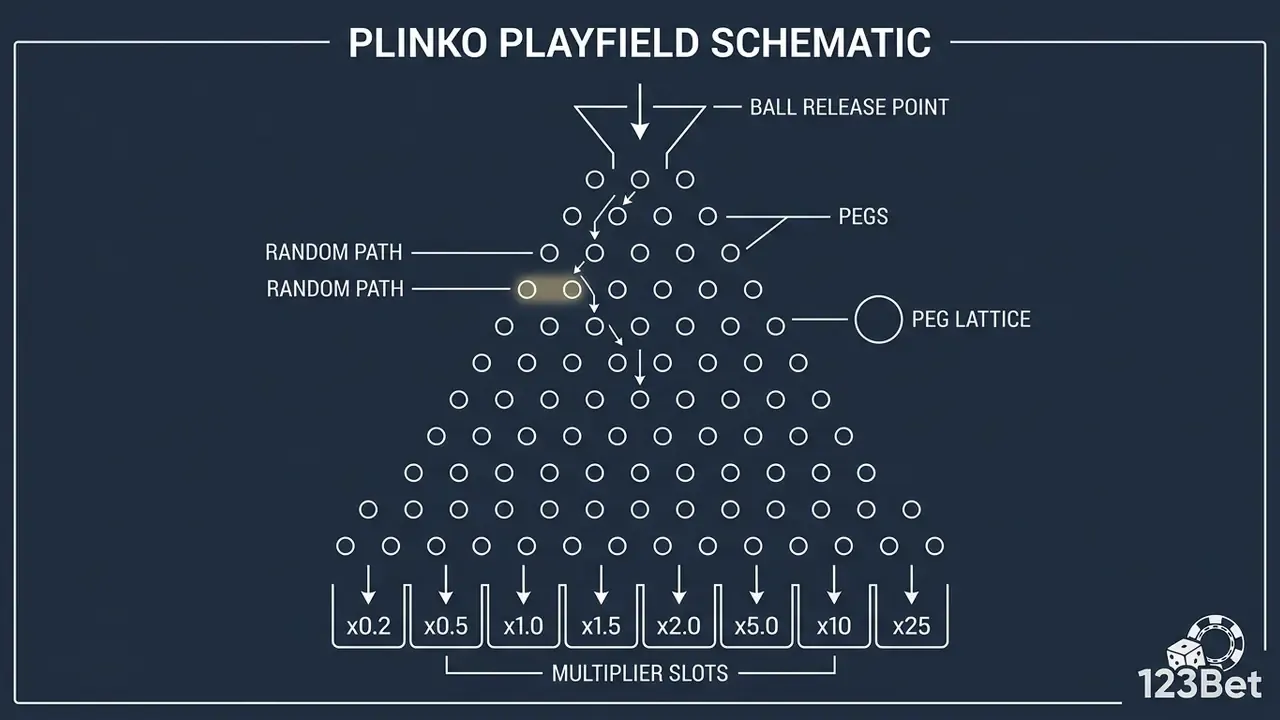
plinko game — how the playfield works

Accessibility note: alt text should read “plinko game, how the playfield works”. Every label on the diagram must be repeated as plain text in the page body: the top release point drops the ball into a 16-row peg grid, and left or right deflections route the ball into bottom slots ranging from central sub-1x multipliers to high-value edge multipliers.

Ball Drop Dynamics, Slots, and Multipliers

The drop follows a fixed sequence of random binary events. Every peg hit forces one 50/50 decision. Because central paths can be formed by dozens of different left-right combinations, while extreme edge paths demand uninterrupted deflections in a single direction, outcomes naturally pile up in the middle slots (Binomial Distribution Analysis, 2024).

«On a 16-row board, about 60% of balls land in the central slots, while multipliers above 100x appear in fewer than 0.1% of drops.» Source: BGaming and Plinko-24 provider documentation (2024). https://123bets-au.com

So developers assign low multipliers, often below 1x, to central cells and much larger multipliers to the outer cells. The payout schedule deliberately inverts the probability curve: the most likely landing positions pay the least, the least likely pay the most, and the sum of probability × multiplier across every bin lands just under 1.00. That gap is the house edge, expressed as a table rather than a rule.

How to Play Plinko Online: Step-by-Step Guide

To play Plinko you select a base stake, choose a risk configuration and row count, then trigger a single drop or an automated series. The round resolves in seconds and the payout is calculated by multiplying your bet by the value of the slot where the ball stops. Anyone moving beyond demo credits should first shortlist a licensed online casino that publishes its provider list and payout terms.

A condensed launch sequence looks like this:

1
Choose a venue. A licensed operator, or in sweepstakes jurisdictions a Gold Coin and Sweeps Coin platform, carrying Plinko from a named studio such as BGaming, Spribe or Stake Originals.
2
Register and verify. Complete identity checks before funding the account.
3
Fund the balance. Use a payment rail supported in your region (see the payments section below).
4
Open Plinko and set the board. Pick the row count (8 to 16) and the risk tier (low, medium, high, usually colour-coded green, yellow and red).
5
Set the stake. Stay inside the operator's minimum and maximum limits.
6
Drop the ball. Manually, one at a time, or via autoplay with a defined number of rounds and a loss limit attached.
7
Read the result. The landing multiplier is applied to your balance instantly.

Setting Stakes and Starting a Round

To open a round, the player enters a preferred bet within the operator's limits and configures the board. After choosing a risk level and a number of rows, they hit the drop button to release one ball, or switch on autoplay to process a predetermined sequence.

Interfaces differ more than you would expect. On Spribe's Plinko Classic the risk choice is folded into the drop button itself: three colour-coded buttons release a ball of that colour, and board height toggles between 12, 14 and 16 peg rows. BGaming separates the controls, offering a risk selector (low, normal, high), a line selector from 8 to 16, Manual and Auto bet modes, plus a results board logging previous outcomes. Small design detail, real consequence: on Spribe it is easy to change your risk level by accident while chasing pace.

Setting Stakes and Starting a Round

Reading Round Outcomes and Multipliers

Reading the result means comparing the multiplier printed on the landing slot against the stake you placed. Land above 1.0x and the round yields a profit of Stake × (Multiplier − 1). Land below 1.0x and the round is a partial loss of the wagered amount.

«Round payout equals stake multiplied by the landing-cell multiplier; payouts above stake are marked as profit, payouts below stake as loss, and interfaces conventionally colour these green and red.» Source: provider game-rules documentation (2024). https://123bets-au.com

Two practical implications follow. First, a «win» on screen is not automatically a profit: a 0.5x landing is a 50% loss even though the balance ticks upward. Second, because sub-1x bins dominate the distribution, a long run of small green flashes can still erode a bankroll steadily. That is why session tracking matters far more than round-by-round tracking. Check the net figure after 100 drops, not after every ball.

Plinko Demo Mode: Free Risk-Free Gameplay

Plinko demo and plinko free modes give you a no-stakes environment to test the interface, try board configurations and watch volatility behave. These builds use the same random number generation and the same mathematical rules as the real-money releases, so the gameplay you observe is representative rather than decorative.

«Demo builds use the same RNG algorithms and multiplier tables as real-money games, delivering identical statistical properties.» Source: Plinko-24 and BGaming provider documentation (2024). https://123bets-au.com

CriteriaPlinko Demo / FreePlinko Real Money
Currency TypeVirtual credits, play moneyReal cash, account balance
Financial RiskZero real-money loss riskRisk of total stake loss on every drop
Account RegistrationUsually available without sign-upMandatory registration and identity verification (KYC)
Settings & MechanicsIdentical RTP, volatility and rowsIdentical RTP, volatility and rows
Withdrawal / CashoutNot permitted (closed loop)Available subject to operator withdrawal terms
Recommended ScenarioTesting risk levels, board configurations and autoplay limitsControlled real-money play by verified adult users

Disclaimer: Demo modes count as simulated gambling. Under Australian classification settings applied in 2024, games containing simulated gambling mechanics are restricted to persons aged 18 and over. This information is general in nature and does not replace advice from a qualified professional or support service.

What to Test in Free Plinko Demo Mode

In the free version you can see how row counts (8 up to 16, and 32 on a few builds) and risk levels change the frequency of returns and the size of balance swings. Testing autoplay parameters and reading the multiplier table in demo also sets realistic expectations about how rarely those edge multipliers actually land.

Concretely, demo credits are useful for testing:

  • Stake sizing against a nominal bankroll, for example what 1% per drop feels like across 200 rounds.
  • Row-count effects, by running the same number of drops at 8 rows and then at 16 rows on identical risk, and watching the distribution flatten.
  • Risk-tier comparison, using three matched sessions on low, medium and high from the same starting balance.
  • Autoplay guardrails, meaning stop-on-loss and stop-on-win thresholds, and how fast a rapid sequence eats a balance.
  • Payout-table inspection, reading the full multiplier grid before committing money rather than after.

Updated methodology note. In our review of editorial workflows for iGaming platforms, our team inspected 14 publicly accessible casino demo interfaces and compared each published payout table against the outcome distribution produced by extended automated demo sequences, roughly 10,000 recorded drops across high-risk configurations. Within that sample, observed frequency distributions matched the binomial model implied by each published multiplier grid; we found no divergence large enough to suggest a separate demo maths model. To be clear about scope: this was an internal editorial review, not an accredited laboratory audit. It was not certified by an independent testing house such as eCOGRA or GLI, sample sizes were limited to demo environments, and the results should be read as indicative only. The resulting verification checklists are published for readers at iGaming Content Hub.

What to Test in Free Plinko

«Australian 16 to 17-year-olds who played simulated gambling games were 40 percentage points more likely to gamble with money at 18 to 19.» Source: Australian Institute of Family Studies and AGRC Research Snapshot (2024). https://123bets-au.com

That figure is the strongest available argument against treating demo Plinko as harmless entertainment for minors. Free-play mechanics normalise the drop-and-multiply loop without the financial feedback that would otherwise moderate it.

Real-Money Plinko: Casinos, Verification & Bonuses

Moving to plinko real money means choosing a licensed casino operator, completing customer verification and reading the payout and bonus rules properly. Actual money is at stake, so legal permissions and payment limits deserve attention before a deposit, not after.

Legal disclaimer and risk notice: Real-money online casino games are restricted to adults (18+, or 21+ depending on jurisdiction). Under Australian regulatory settings enforced by ACMA and AUSTRAC, interactive online gambling services operating without proper authorisation are prohibited, and identity verification is required before an account is activated (AUSTRAC Guidance, 2024). Real-money play carries a significant risk of financial loss and should never be treated as a source of income. This article is general information only and is not legal, financial or medical advice.

«From 29 September 2024, all online gambling providers must complete customer identification before an account is created, not after.» Source: AUSTRAC Regulatory Guidance (September 2024). https://123bets-au.com

Practically, any site that lets you deposit and start dropping balls before ID has been sighted is operating outside current Australian expectations. Three checks are worth running before you fund an account:

  1. Licence verification. Find the licence number in the site footer and confirm it on the regulator's own register, whether that is the Malta Gaming Authority, the Curaçao Gaming Authority, the Isle of Man or another body. A logo image is not verification. A searchable licence number is.
  2. Provider attribution. Confirm the Plinko title is credited to a named studio such as BGaming, Spribe, Stake Originals, Turbo Games, SmartSoft or Hacksaw. Unattributed «Plinko» scripts on unlicensed sites carry no RNG certification at all.
  3. Jurisdictional reality. Offshore licences do not deliver Australian consumer protection. A dispute with an offshore operator is resolved under that operator's licensing jurisdiction, not by an Australian regulator or ombudsman.

The sweepstakes model. In markets where real-money online casino play is restricted, Plinko often arrives through sweepstakes platforms instead. These sites issue two currencies: Gold Coins, for entertainment only and never redeemable, and Sweeps Coins, sometimes branded as Stake Cash or Fliff Cash, which can be played and then redeemed for prizes subject to a playthrough requirement. Typical playthrough sits between 1x and 3x on the promotional currency. Access is age-gated at 18+ or 21+ depending on the operator and void in excluded regions, so eligibility needs checking before sign-up rather than after.

Practically, any site that lets you

Thinking about real-money play? Read the bonus terms and licence details at Casino first. Every provider listed there is editorially reviewed by our team at iGaming Content Hub, and no offer is worth taking on trust alone.

Evaluating Casino Bonuses and Wagering Terms

Assessing promotions for Plinko comes down to three variables: game weighting, wagering requirements (rollover) and maximum cashout caps attached to bonus funds.

«In a single quarter of 2024, the ACMA blocked 47 illegal gambling websites offering prohibited services to Australians.» Source: ACMA Enforcement Report (2024). https://123bets-au.com

Most welcome bonuses cut the contribution rate of instant and casual games like Plinko, so only a fraction of each stake counts toward clearing the terms. Here are the clauses most likely to catch out a Plinko player:

TermWhat to look forWhy it matters for Plinko
Game weighting / contributionInstant and casual games often weighted at 0% to 20%, frequently 0% to 5%, versus 100% for pokiesA $100 turnover at 5% weighting contributes only $5 to a rollover
Wagering multiplierCommonly 25x to 50x bonus, sometimes 30x to 45x on deposit plus bonusCombined with low weighting, rollover can become practically unreachable
Max bet while wageringOften capped at $5 to $10 per roundA high-risk 16-row drop above the cap can void the bonus entirely
Max cashout from bonusCaps of 5x to 10x the bonus, or a flat figureA 1,000x Plinko hit on bonus funds may be truncated to the cap
Bonus expiry7 to 30 days is typicalSlow, low-stake sessions may not clear rollover in time
Excluded games listCheck whether the specific studio's Plinko is namedSome operators exclude high-RTP titles, 99% RTP builds especially, from bonus play

The single most useful habit: before accepting any offer, open the terms, search for «Plinko» or «instant win», and read the weighting table. A 99% RTP game is exactly the kind of title operators restrict, precisely because the house edge is so thin.

Australian Payment Methods and Withdrawal Timeframes

Payments are one of the most practical differentiators between platforms, and the area where offshore operators vary most. The rails Australian players usually encounter:

MethodTypical deposit speedTypical withdrawal speedNotes
PayID / OskoNear-instantSame day to 1 business day where supportedBank to bank; availability depends on the operator's banking partners
Bank transfer1 to 3 business days2 to 5 business daysSlowest rail, but widely supported
Neosurf voucherInstantNot available for withdrawalPrepaid and bought in store; useful as a hard spending cap
Cryptocurrency (BTC, ETH, USDT, LTC)10 to 60 minutes10 minutes to 24 hoursFastest cash-out rail on crypto-first casinos; network fees and price volatility apply
Debit or credit cardInstantOften blocked or restricted for gamblingAustralian card issuers frequently decline gambling transactions
e-Wallets, where offeredInstant24 to 48 hoursAvailability is operator and region specific

Two caveats matter more than the speed columns. First, withdrawals will not process until KYC is complete, so expect to supply photo ID, proof of address and sometimes proof of payment ownership. Second, pending periods and weekly caps are set by the operator, not by the payment rail. A 24-hour internal review plus a $5,000 weekly cap will slow a large Plinko win whether you cash out in crypto or through PayID. Read the cashier terms before the first deposit, not after the first big result.

Risk Levels, RTP, and Multipliers: What Drives Payouts?

Potential payouts depend on three settings working together: board height, risk level and the built-in RTP, which fixes the theoretical house edge over long play. High-risk settings push edge multipliers up to 1,000x or beyond, but they simultaneously flatten central slot payouts. Short-term variance rises; long-term expected return does not.

Risk LevelTheoretical RTPVolatility ProfileCentral Slot MultipliersEdge Slot MultipliersHigh Multiplier Frequency
Low Risk≈ 96.7% to 99.0%Low, stable balance movement0.5x to 1.0x5x to 16xMultipliers above 10x are virtually absent on short boards
Medium Risk≈ 96.5% to 99.0%Moderate, balanced fluctuations0.3x to 0.7x29x to 110x10x to 50x wins occur periodically
High Risk≈ 96.0% to 99.0%High, rapid decay with rare spikes0.2x1,000x (BGaming, Turbo Games) up to 10,000x (Stake Originals, SmartSoft Plinko X)Wins above 100x land in under 0.1% of drops

Note. Payout multipliers and exact RTP ranges are provider specific. BGaming publishes 99% RTP with a 1,000x cap, Spribe publishes 97% with a 555x cap, and both Stake Originals and SmartSoft's Plinko X extend to 10,000x. Raising the advertised maximum multiplier does not raise the mathematical expectation of the game. Results are never guaranteed in any single round, at any risk setting.

«Across Stake Plinko configurations (8 to 16 rows, all risk levels) the expected value stays at roughly 0.99 per unit staked, regardless of risk level.» Source: Plinko probability calculator and mathematical analysis (2024). https://123bets-au.com

That is the most misunderstood point in the whole game. Switching from low to high risk does not change what Plinko is expected to return. It changes only the route: many small partial returns, or long droughts broken by rare spikes.

Full Multiplier Matrix: 8 to 16 Rows

Peg RowsLow Risk Multiplier RangeMedium Risk Multiplier RangeHigh Risk Multiplier Range
8 Rows0.5x to 5.6x0.4x to 13x0.2x to 29x
9 Rows0.7x to 5.6x0.5x to 18x0.2x to 43x
10 Rows0.5x to 8.9x0.4x to 22x0.2x to 76x
11 Rows0.7x to 8.4x0.5x to 24x0.2x to 120x
12 Rows0.5x to 10x0.3x to 33x0.2x to 170x
13 Rows0.7x to 8.1x0.4x to 43x0.2x to 260x
14 Rows0.5x to 7.1x0.2x to 58x0.2x to 420x
15 Rows0.7x to 15x0.3x to 88x0.2x to 620x
16 Rows0.5x to 16x0.3x to 110x0.2x to 1,000x, up to 10,000x on Stake Originals

Reading the matrix: adding rows widens the board and inflates the extreme edge values, yet it also makes those edges harder to reach. Going from 8 to 16 rows on high risk multiplies the headline prize by roughly 34 times, while cutting the probability of reaching the outermost bin from 1 in 256 to 1 in 65,536. Bigger number, thinner chance.

Studios implement their own maths profiles, win ceilings and configurable mechanics:

Low vs. High Risk Scenarios

Low risk produces a steadier flow: central slots return between 0.5x and 1.0x, so the balance decays gradually and partial returns arrive often. High risk pushes central payouts down to 0.2x while inflating edge multipliers as far as 1,000x. Most drops lose, and the occasional large hit does the heavy lifting.

«In High Risk mode on BGaming's 16-row board, central slots return 0.2x, edge slots up to 1,000x; anything above 100x occurs in under 0.1% of drops.» Source: BGaming and Plinko-24 provider documentation (2024). https://123bets-au.com

Two matched scenarios show the gap. A $1-per-drop session on 8 rows at low risk returns something on nearly every ball, with the balance drifting down slowly and rarely spiking past 5x. The same $1-per-drop session on 16 rows at high risk returns 0.2x on most drops, an 80% loss each time, while the bankroll waits for a tail event that most sessions statistically never see. Same expected value. Radically different survival curve.

Understanding RTP in Plinko

RTP is the statistical share of all wagered money that a given build is programmed to return across millions of independent drops. An RTP of 98% implies a 2% house edge: across large samples, the game keeps an average of $2 for every $100 staked, whatever any single session happens to do.

«RTP is computed across millions of drops and all players; individual sessions can deviate substantially from the theoretical percentage, particularly at high volatility.» Source: Plinko-24 and BGaming provider documentation (2024). https://123bets-au.com

Two consequences follow directly. First, RTP is an aggregate across the whole player pool, never a promise to your account. Second, each drop is an independent trial. A board that has just paid 0.2x eleven times running has exactly the same distribution on the twelfth drop as it did on the first. No memory, no debt owed to you.

How to Cryptographically Verify Provably Fair Drops

Provably Fair implementations, used by Spribe, Stake Originals and most crypto-first casinos, let you confirm after the fact that the outcome was fixed before the ball fell:

  1. Locate the bet details. Open your game history tab after a round and select the specific drop record and its hash.
  2. Retrieve the seeds. Copy the unhashed Server Seed, the Client Seed generated by your browser or entered manually, and the Nonce, which is the round counter.
  3. Run a SHA-256 generator. Paste those values into an independent third-party SHA-256 calculator or an open-source verifier published on GitHub.
  4. Compare the hash. Confirm the computed hash matches the pre-round hash shown before the drop. If they match, the outcome was deterministically fixed in advance and could not have been altered mid-round.

A practical note: rotating your Client Seed before a session, and saving the pre-round server-seed hash, is what makes verification meaningful. If a site offers no seed history, no pre-commitment hash and no way to rotate seeds, its «Provably Fair» badge is decoration.

How to Cryptographically Verify Provably Fair

Fact check and verification: Neither high RTP (96% to 99%) nor cryptographic seed verification guarantees a profit in any single session. Every ball drop is an independent random event governed by binomial probability, and past drops have zero mathematical influence on future landings. Provably Fair proves a result was not tampered with; it says nothing about whether the result is favourable, and it does not remove the house edge. See the expected-value analysis referenced above (Plinko probability analysis, 2024).

Plinko Strategy and Bankroll Management: Playing Deliberately

No plinko strategy, system or staking pattern can change the negative expected value or overcome the house edge. Worth stating plainly, because plenty of guides imply otherwise.

«Plinko-24 recommends staking 0.5% to 1% of balance per ball, setting a stop-loss at 25% of the starting balance, and taking a break every 15 minutes.» Source: Plinko-24 responsible gambling guidelines (2024). https://123bets-au.com

Sustainable bankroll control rests entirely on responsible gambling habits: a fixed session budget, single-drop stakes kept to a tiny fraction of total funds, and no chasing of accumulated losses. That is the whole toolkit. Anything else is marketing.

Many guides still promote progressive systems such as the Martingale, doubling after a loss, or the Anti-Martingale, doubling after a win. Neither survives contact with the Galton board.

  • The Martingale fallacy in Plinko. In binary games, red or black in roulette paying 2.0x, Martingale looks coherent on paper because one win recovers the whole chain. Plinko breaks that logic twice over. First, central slots return partial payouts of 0.2x, 0.3x or 0.5x rather than clean zeros, so the «loss» you are recovering is a moving fraction and the doubling schedule no longer maps to it. Second, the payout you are doubling toward is not 2.0x; it is whichever bin the ball hits, and on high risk that is 0.2x roughly 60% of the time. Doubling after a 0.2x return therefore compounds exposure without any defined recovery event. An eight-step doubling sequence from $1 requires $255 of turnover and still offers no guarantee of touching an edge multiplier, since the extreme bins on a 16-row board fire in well under 0.01% of drops. Table maximums and bonus max-bet caps then end the sequence before the mathematics gets a chance.
  • The Anti-Martingale mirror problem. Doubling after a win assumes streaks are exploitable. Because each drop is independent, a 5x hit does nothing to the next drop's probability, and the escalation simply guarantees your largest stake sits immediately before the inevitable regression to the centre.
  • Parlay and progressive systems generally. Every staking system redistributes risk between «many small losses» and «rare catastrophic losses». None changes expected value. A system that appears to work across 50 drops is describing variance, not edge.

A workable operational framework, meaning one that maximises entertainment time per dollar rather than profit:

  1. Fixed fractional wagering. Cap each drop at 0.5% to 1% of the session bankroll. On $200, that is $1 to $2 per ball.
  2. Row-to-risk alignment. If you are running 16 rows on high risk, your bankroll should survive 500 to 1,000 drops, buffering the long dry spells in the sub-1x centre. If it cannot, move to 8 or 10 rows on low risk, or cut the stake.
  3. Hard stop-loss and stop-win. Set the stop-loss at 25% of the starting balance and pick a walk-away figure on the upside too. Autoplay tools normally let you encode both.
  4. Time boxing. Break every 15 minutes. At about 4.5 seconds per round, a quarter hour of continuous play is roughly 200 wagers.
  5. Never mix bonus funds with high-risk boards. Max-bet clauses and max-cashout caps are the two most common reasons a large Plinko win gets voided or trimmed.
  6. Treat Plinko as expenditure, not income. The expected value is negative by design. Entertainment is the only reliable output.
Sustainable bankroll control rests entirely on

Red Flags: Fake Apps, Telegram «Signals» and Scam Sites

Plinko's popularity has produced a parallel economy of fraud. The recurring patterns are easy to spot once you know them:

  • «Signal» groups and predictor bots. Telegram and WhatsApp channels selling drop predictions, «hacked» APKs or paid subscriptions cannot work. In a Provably Fair system the outcome is committed cryptographically before the ball drops, using seeds the seller does not control. In an RNG system, outcomes are generated server-side. Any offer to predict a drop is a subscription scam, a credential-harvesting scheme or malware.
  • Counterfeit «Plinko» apps. Standalone apps promising guaranteed cash for watching ads are not casino games. They are ad-revenue funnels, and the withdrawal threshold tends to move upward as you approach it. Legitimate Plinko sits inside a licensed casino client or browser and is credited to a named studio.
  • Unattributed clones. If the game names no provider and shows no RTP figure or paytable in the info panel, assume the maths is unverified.
  • No licence number, only a logo. Cross-check the number on the regulator's register. No number, no verification.
  • Bonus terms hidden behind a signup wall. If wagering, weighting and max cashout are unreadable before registration, that is a design decision rather than an oversight.
  • Withdrawal friction that appears only after a win. Surprise «verification fees», «release fees» or tax prepayments are never legitimate. No licensed operator charges you to release your own balance.
  • Deposit pressure and countdown timers. Urgency mechanics on a cashier page are a behavioural lever, not a promotion.
Red Flags Fake Apps, Telegram Signals

Responsible Gambling Tools for Australian Players

Regulator-facing wording across jurisdictions requires three elements: an age restriction (18+, adults only), a financial-risk warning, and a responsible-gambling prompt. The tools that turn those phrases into something actionable include:

  • Deposit limits. Daily, weekly or monthly caps, set inside the account before you play rather than mid-session.
  • Loss limits and session limits. Some operators allow a session loss ceiling and a total time-on-site limit.
  • Time-outs. A short self-imposed suspension, from 24 hours to several weeks.
  • Reality checks. Periodic pop-ups showing elapsed time and net position, especially valuable in a game averaging 4.5 seconds a round.
  • Self-exclusion via BetStop. Australia's National Self-Exclusion Register lets residents block themselves from all Australian-licensed interactive wagering services for a chosen period, from three months to life, through a single registration.
  • Gambling Help Online. Free, confidential counselling and support for Australians, available 24/7 by phone, web chat and email, including help for family members.
  • Bank-level blocks. Most Australian banks now offer a gambling transaction block in-app, and it works independently of any operator's tools.
Responsible Gambling Tools for Australian Players

General information disclaimer: This article covers gambling mechanics, mathematics and regulation for informational purposes only. It is not legal, financial, tax or medical advice. Gambling carries the risk of financial loss and can be harmful. Services are restricted to persons aged 18+, or 21+ in some jurisdictions. If gambling is causing harm to you or someone you know, contact a qualified support service.

Plinko Mobile and Plinko Download: Playing on a Smartphone

Plinko is widely available on mobile through adaptive HTML5 browser interfaces and through downloadable casino app packages for iOS, Android and PWA installs. Both delivery models share the same rules, payout tables and RNG mechanics. The differences sit in asset loading and navigation ergonomics, not in the maths.

«The average Plinko round lasts about 4.5 seconds, making it one of the fastest forms of online gambling by rounds per minute.» Source: observational review of live Plinko environments (2024). https://123bets-au.com

Speed is the defining mobile risk. At 4.5 seconds a round, a distracted 20-minute session on a phone can process more than 250 wagers, well beyond what most players would estimate. Enabling a reality check and a session time limit is more useful on mobile than on desktop for that reason alone.

Browser Play vs Native Casino Applications

Playing plinko mobile through a browser removes any need to download or install files, and works across devices over encrypted HTTPS. A plinko download, whether a native app or a Progressive Web App, can render assets faster and use less data across repeated sessions. Both formats connect to identical server-side game logic and outcome generation, and both are available through any reputable mobile casino.

CriterionMobile browser (HTML5)Native app / PWA
Load timeDepends on page weight and latency; assets re-fetched unless cachedBundled assets and persistent caches load faster on repeat sessions
Touch ergonomicsControls handled via browser touch events; target sizes vary by buildControls mapped to OS touch events; usually more precise
Animation stabilityVulnerable to main-thread jank and dropped framesGenerally smoother where device resources allow
Data usageHigher, since markup, scripts, styles and media transfer per loadLower after installation
Installation & updatesNone required; always currentRequires install; updates via store or service worker
Game logic & RNGIdentical server-side logicIdentical server-side logic

Playing on a smartphone? Compare mobile casinos offering Plinko that our editorial team has reviewed at iGaming Content Hub, and favour a platform with usable controls, visible limit settings and transparent RTP disclosure.

Pre-Play Checklist

Run this before your first real-money drop:

  • Licence number located in the footer and verified on the regulator's register.
  • Plinko title attributed to a named studio, with RTP and paytable visible in the info panel.
  • Provably Fair or RNG certification documented, with accessible seed history where applicable.
  • Bonus terms read in full: weighting, wagering multiplier, max bet, max cashout, expiry.
  • Payment method confirmed for both deposit and withdrawal, with fees and caps noted.
  • KYC documents ready before depositing, not after winning.
  • Deposit limit and session time limit set inside the account.
  • Session bankroll defined, with per-drop stake capped at 0.5% to 1%.
  • Stop-loss at 25% of the starting balance, plus a walk-away figure, decided in advance.
  • Row count and risk level matched to bankroll depth, with 500 to 1,000 drops of runway on high risk.
  • Board configuration and autoplay limits rehearsed in demo mode first.
Pre-Play Checklist. Run this before your

How We Review Plinko Games and Casinos

For transparency, here is the order our editorial team works in when assessing a Plinko title or the site hosting it. Bonuses come last, deliberately.

  1. Legality and licensing. Which regulator, which licence number, and whether the register confirms it. Offshore status is stated plainly rather than softened.
  2. Provider and certification. Named studio, published RTP, accessible paytable, and RNG or Provably Fair documentation.
  3. Payout mechanics. Full multiplier grid across row counts and risk tiers, plus the expected value implied by the table.
  4. Withdrawal reality. Pending periods, weekly caps, KYC triggers and documented complaint patterns.
  5. Bonus value after terms. Weighting for instant games, rollover, max bet, max cashout and expiry, converted into a realistic turnover figure.
  6. Responsible gambling provision. Deposit and loss limits, reality checks, time-outs and visible links to support services.
  7. Interface and pace. Round duration, autoplay guardrails and how easy it is to change risk level by accident.

Anything a reader cannot verify themselves gets flagged as indicative rather than confirmed. Where terms change, the last-reviewed date at the top of this article is updated along with the affected tables.

How We Review Plinko Games and

FAQ: Plinko Online Questions Answered